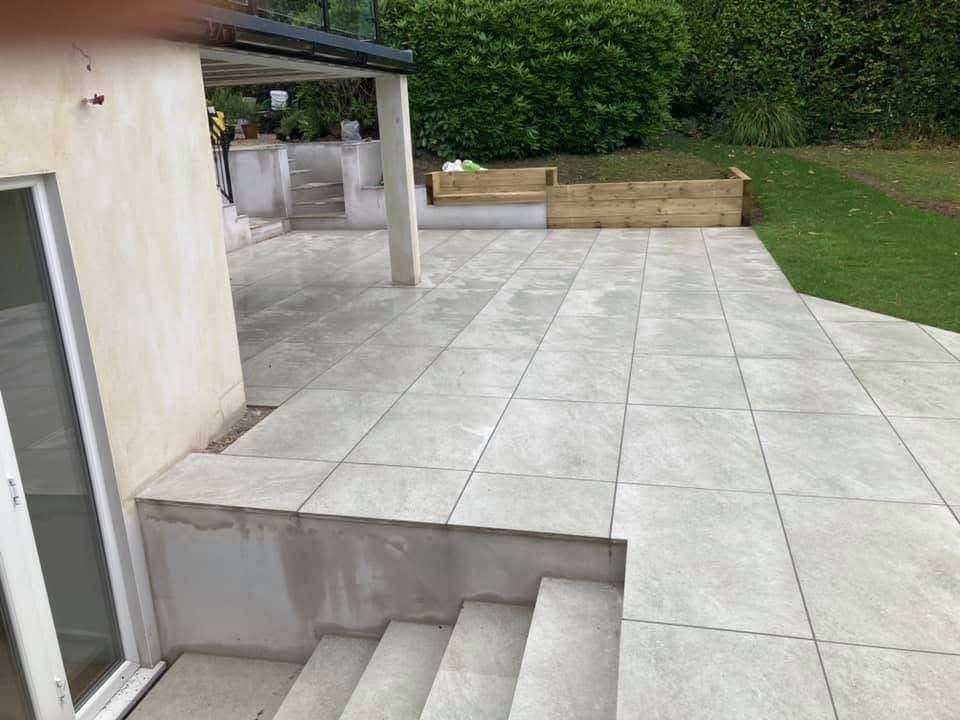
Most people choosing a new patio think about the stone, the colour and the size. Very few think about where the rain goes. Yet when we are asked to look at a patio that has gone green, cracked, or turned into a pond every time it rains, the cause is nearly always the same: the water had nowhere to go.
A patio is a large, hard surface. Every drop that lands on it has to run somewhere, and in a wet Dorset winter that is a lot of water. Getting the fall and the drainage right is one of the least glamorous parts of the job, but it is the part that decides whether a patio still looks good in ten years.
What a fall actually is
A fall is a slight slope built into the patio so that water runs off rather than sitting on top. It is gentle enough that you will not notice it when you put a table and chairs out, but enough to move rainwater steadily towards the edge, a lawn, a border or a drain.
The direction matters as much as the slope. A patio laid against the house should always fall away from the building, never towards it. Water running back towards your walls can soak into brickwork and, over time, lead to damp problems inside. The finished surface also needs to sit comfortably below the damp-proof course of the house, so that rain splashing off the patio does not bridge it.
Why the ground under your garden matters
Across Poole, Bournemouth and the towns around them, the ground varies a great deal from one street to the next. Some gardens sit on sandy soil that drains quickly. Others have heavier clay, which holds water and can stay soft and wet for weeks after a downpour.
On free-draining sandy ground, water running off the edge of a patio usually soaks away into the lawn or border without much fuss. The bigger risk there is the opposite: sand can wash out from under poorly edged paving, leaving slabs to settle.
On clay, the water has much less chance of disappearing. If a patio simply sheds its rain onto a clay lawn, that lawn can turn boggy along the edge, and water can work its way back under the slabs. Clay also swells when wet and shrinks when dry, which puts movement into anything built on a weak base. In gardens like these, we plan where the water ends up before a single slab goes down.
Where the water goes
There are a few common ways to deal with run-off, and the right one depends on the garden.
The simplest is to let the patio fall towards a lawn or planted border that can take the water. That works well on sandy ground and on smaller patios.
Where the ground cannot cope, a linear channel drain along the low edge collects the water and carries it away, either to an existing drain or to a soakaway. A soakaway is essentially a pit filled with material that holds the water and lets it seep into the ground slowly. It needs to be sized and positioned properly, and kept well away from the house.
On sloping plots, which are common around Broadstone and Wimborne, the patio often has to work alongside retaining walls and steps. Here the drainage behind the walls matters too, because water building up behind a wall puts real pressure on it.
The base does more than you think
A good fall on the surface only helps if the base underneath is right. The sub-base needs to be dug out to a proper depth, built from compacted hardcore, and shaped to the same fall as the finished surface. If the base is flat and the slope is made up in the bedding layer alone, the patio will drain at first, then sink and dip in the places that carry the most weight and water.
This is also where cheaper patios tend to go wrong. A thin base on clay will move, and once a slab drops out of line it starts to hold water, which turns green, then slippery, then cracks in a frost.
How the paving itself plays a part
Porcelain is very hard wearing and absorbs almost no water, which makes it a great choice for Dorset gardens, but it also means every drop runs off the surface rather than soaking in. That makes the fall and the drainage plan even more important. Natural stone such as sandstone is more porous and will take on some water, which is one reason it can weather and mark more over time.
The joints matter too. Properly filled joints keep water running across the surface instead of down into the bedding, where it can wash material out and loosen slabs.
Signs your existing patio has a drainage problem
If you already have a patio and are not sure whether it drains well, have a look after a heavy shower. Puddles that are still there a few hours later, green or black staining in the same spots, slabs that rock underfoot, and damp patches on the house wall near the patio are all worth taking seriously. Sometimes a channel drain or relaying a section is enough. Sometimes the base needs doing again.
What we would suggest
If you are planning a new patio, ask whoever quotes for it where the water will go, which way the patio will fall, and how deep the base will be. A good installer will have a clear answer to all three before they start.
We have been laying patios and driveways for 23 years, and drainage is part of every job we price, not an afterthought. All our workmanship comes with a 3-year guarantee, our slabs carry a 5-year warranty, and we are fully insured.
If you are in Poole, Bournemouth, Broadstone, Wimborne or Ferndown and want a patio that copes with whatever the weather throws at it, get in touch for a free quote and we will come and have a look at your garden.