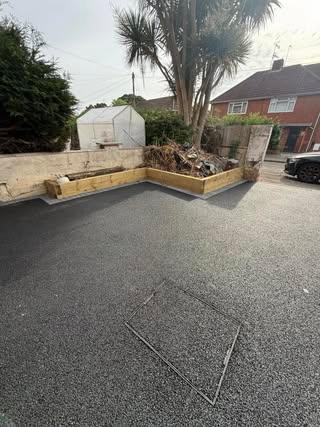
Resin, block paving or gravel is the question most people ring us with: they know they want the driveway done, but not what they want it done in. That's fine. It's the right question to ask before you spend the money, because the three common surfaces behave very differently once they're down.
Here's how we'd explain it standing on your drive.
Resin bound
Resin bound is stone mixed with a clear resin and trowelled out to a smooth, seamless finish. It's the surface people usually picture when they say they want something that looks "finished".
The practical advantage is that it's permeable: rain drains straight through it rather than running off into the road. That matters in the UK, because a driveway that lets water through generally avoids the planning headache that comes with covering a front garden in something solid. It also means no puddles sat in the same spot every winter.
It sweeps clean, doesn't shift underfoot, and there are no joints for weeds to come up through. The catch is that it's only as good as the base underneath it. Resin laid on a tired old sub-base will fail, and no amount of nice stone on top will save it. If someone quotes you a resin drive without talking about what's going underneath, be wary.
Block paving
Blocks have been the default for years and there's a reason. They're hard-wearing, they come in a huge range of colours and patterns, and if a section ever gets damaged or you need to dig up a service, you lift the blocks and put them back.
The trade-off is the joints. Sand between blocks is where weeds and moss make their home, and blocks can sink or lift over time if the base or the edge restraints weren't done properly. A well-laid block drive stays flat for decades; a badly laid one starts moving in a couple of winters.
Expect to give it a wash and re-sand every few years to keep it looking sharp.
Gravel
Gravel is the cheapest way to get a usable driveway, it drains freely, and it's noisy in a way a lot of people actually like: you hear a car pull up.
The problem is containment. Loose gravel migrates: onto the pavement, into the road, into the flowerbeds, and into the house on the soles of shoes. It needs topping up, raking level, and a proper edge to hold it in. If you've got a slope, it'll end up at the bottom of it.
Laid into a stabilising grid with decent edging, gravel is a genuinely good option. Tipped loose onto membrane, it's a job you'll be redoing.
So which one? If you want the tidiest finish and the least ongoing work, resin. If you want something traditional, repairable and available in every colour going, block paving. If budget is the main driver and you don't mind topping it up, gravel, done properly with edges and a grid.
What matters more than any of it is the preparation. Excavating to the right depth, getting the sub-base compacted, and sorting the drainage and edges is what decides whether a driveway still looks right in ten years. The surface is the part you see; the base is the part that lasts.
Happy to come and look at yours and tell you honestly what we'd do with it. There's no charge for the visit and no obligation to go ahead.