It's one of the first things people ask us when they're thinking about a new driveway: do I need planning permission for this? For most houses the honest answer is no, as long as the driveway is built the right way. Get the surface or the drainage wrong, though, and a straightforward job can turn into a planning application.
Here's how it works for a typical house in Poole, Bournemouth, Broadstone or Wimborne, and the two things that catch people out.
The rule that matters for front gardens
Since 2008, the rules in England have changed what you can put across a front garden. If you're laying a new or replacement hard surface in front of the house and it covers more than five square metres, you need planning permission unless one of two things is true. Either the surface itself is permeable, so rainwater soaks through it, or the water that runs off it is directed onto a lawn, a border or a soakaway within your own boundary.
Below five square metres, it doesn't apply. Most driveways are a good deal bigger than that, so in practice the rule covers nearly every job we price.
The reason behind it is flooding. Every front garden that gets covered in solid concrete or tarmac sends a bit more rainwater straight into the drains, and across a whole town that adds up. The rule is there to stop driveways making the problem worse.
What counts as permeable
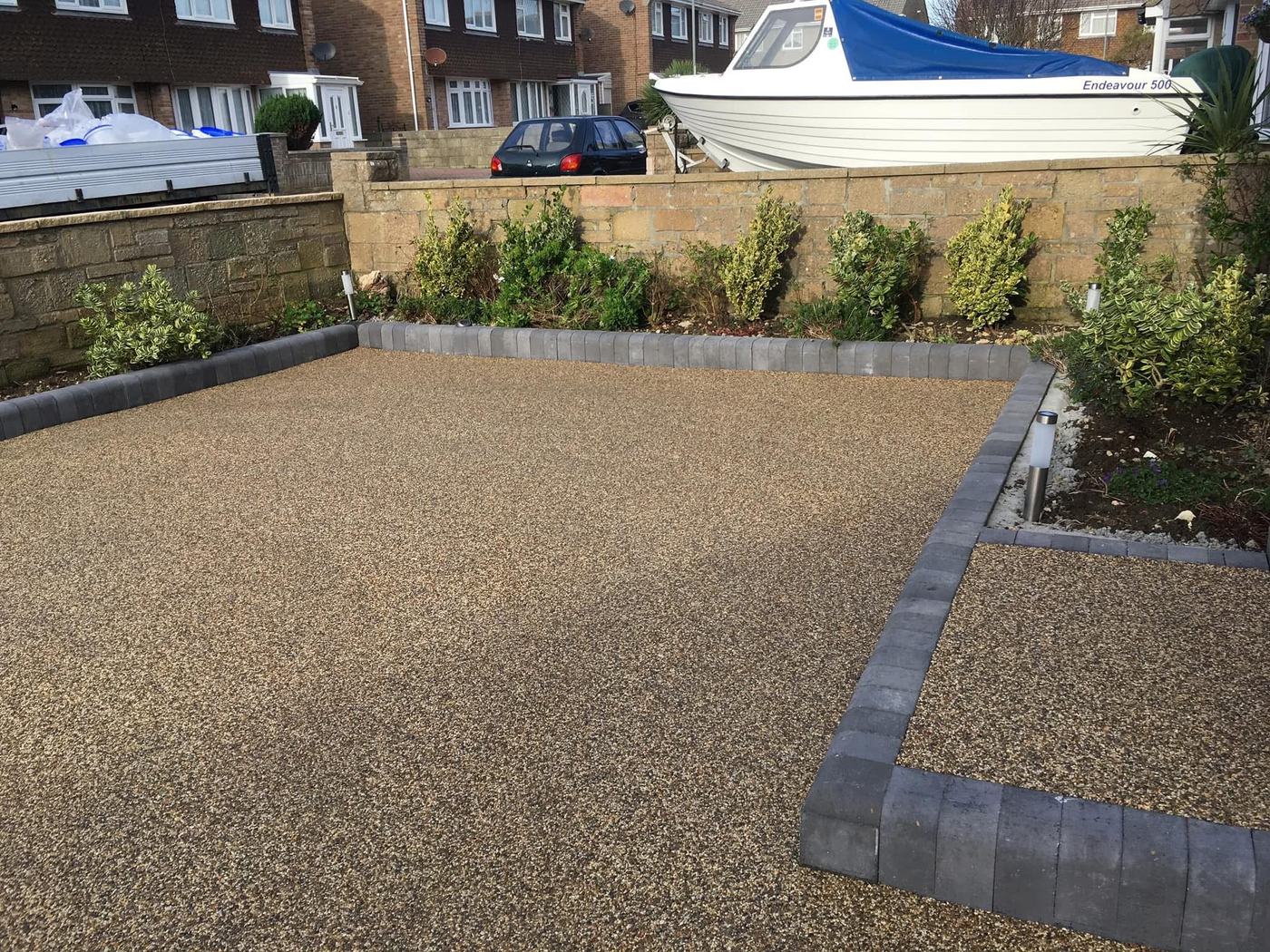
This is where the choice of surface starts to matter. A resin-bound driveway laid over a permeable base lets water drain straight through it, which is one of the reasons it has become so popular for front gardens. Permeable block paving, laid with wider joints and an open-graded base, does the same job. Gravel, with a proper edge and a grid underneath, is permeable too.
Standard tarmac, plain concrete and block paving on a solid base aren't permeable on their own. They can still be fine without planning permission, but only if the water is properly dealt with: shedding to a lawn or border, or collected and taken to a soakaway on your own land.
The detail people miss is that a surface is only as permeable as what's under it. Resin laid over an old concrete slab, or over a sub-base that's been compacted with the wrong material, won't drain the way it should. That's not just a planning problem. Water that can't get away sits under the surface, and that's what lifts and cracks a driveway over a few winters.
When planning still applies
The five square metre rule covers ordinary houses. It works differently in a few situations, and it's worth checking with the council before any work starts if any of these fit:
Flats and maisonettes don't have the same permitted development rights as houses, so a new driveway usually needs an application.
Listed buildings need listed building consent for most changes, and a conservation area can have its own restrictions on front gardens and boundaries.
Some streets have what's called an Article 4 direction, which removes certain permitted development rights. The council can tell you whether your road has one.
None of this is meant to put you off. It's just that a five-minute check with the council is far cheaper than finding out after the driveway is down.
Dropped kerbs are a separate question
This is the one that catches people out most. Even if your driveway doesn't need planning permission, you can't just start driving over the pavement to reach it. Crossing the footway needs a dropped kerb, and a dropped kerb needs approval from the council as the highway authority.
That's a separate application from planning, with its own fee and its own checks. The council looks at things like visibility, how close you are to a junction, whether there's a street tree or a lamp post in the way, and whether there's enough depth in front of the house to park without overhanging the pavement. If your house is on a main or classified road, you may need planning permission for the new access as well.
The kerb itself has to be done by the council or a contractor it approves, so it isn't something a driveway installer can just add to the job. What we can do is make sure the driveway itself is set out to line up with where the dropped kerb will go, and that the levels work, so you're not left with a lip or a puddle at the edge of the pavement.
How we handle it
When we come out to price a driveway, we'll talk through which surface suits your house and how the water will get away, whichever material you choose. If you're going for a non-permeable surface, the drainage is part of the price, not an afterthought. If you need a dropped kerb and haven't got one yet, we'll tell you so before you commit to anything, so the order of work makes sense.
We've been in the trade for 23 years, and the jobs that go well are the ones where these questions get answered at the start rather than halfway through.
If you're thinking about a new driveway and you'd like someone to look at it properly, get in touch for a free quote. We'll come out, have a look, and give you a fixed price in writing.