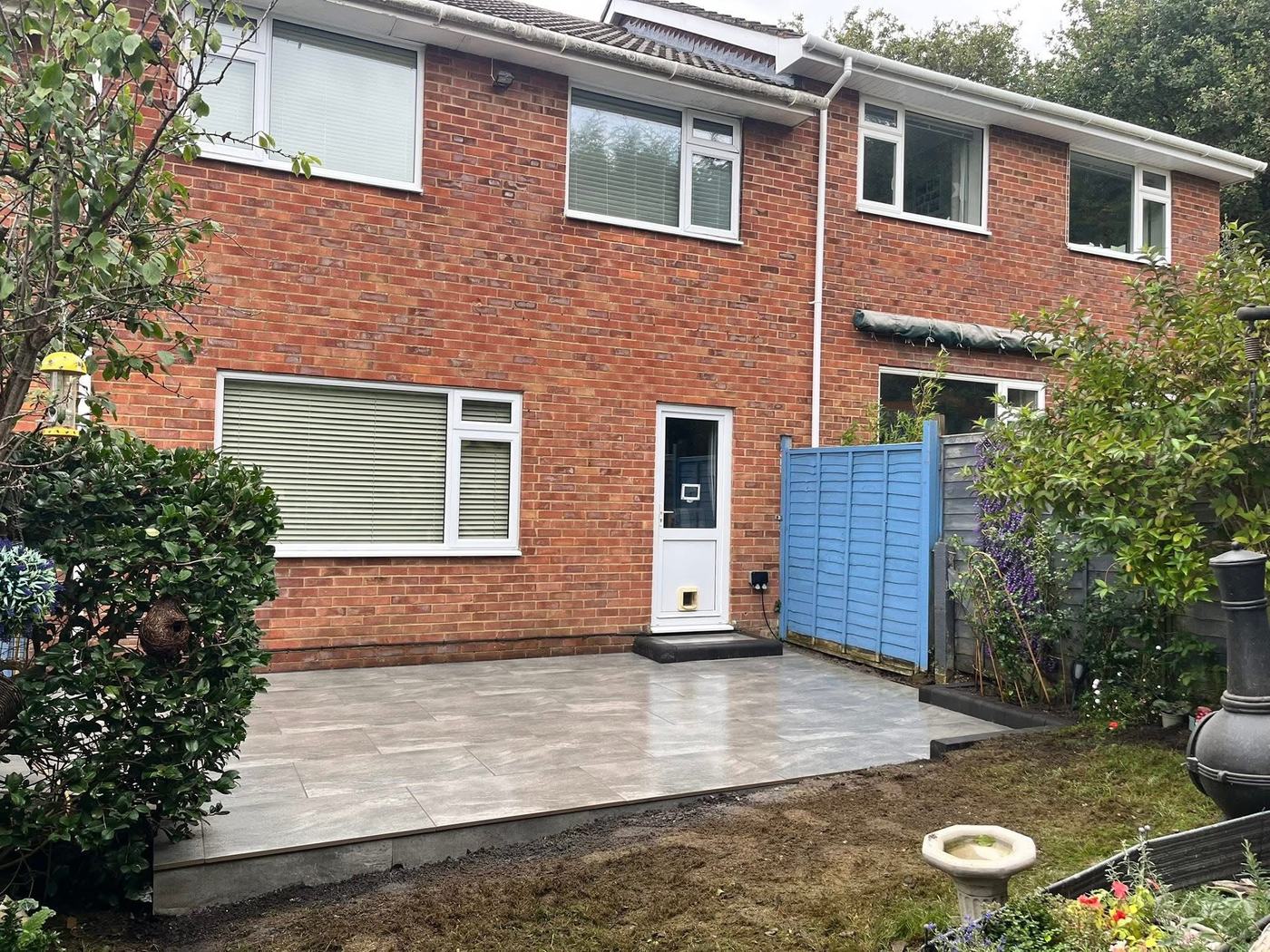
One of the first things people ask when they're planning a new patio is how long it will take. It's a fair question. A patio job means skips on the drive, a mixer in the garden and the back door out of use for a while, so it helps to know what you're signing up for.
The honest answer is that it depends on the size of the patio, what's there now, the material and the weather. But the stages are the same on almost every job we do across Poole, Bournemouth, Broadstone and Wimborne, and once you know them, the timescale makes a lot more sense.
Before anyone picks up a spade
The work starts before the first day on site. We come out, look at the space, talk through how you want to use it and measure up. That's when the big decisions get made: porcelain or natural stone, the size of the slabs, where the patio meets the house, which way the water will run and whether any steps or walls are needed.
Then there's ordering. Some slabs are in stock at the merchants, others have to be ordered in, and a particular colour or size can take longer to arrive. It's worth choosing your paving early, because waiting on materials is one of the most common reasons a start date moves.
Clearing and digging out
The first days on site are the least glamorous and among the most important. Old slabs, concrete, turf and soil all have to come out, down to a depth that leaves room for a proper base. How long that takes depends heavily on what's already there. Lifting a tired old patio and breaking out concrete is slower than stripping a lawn, and access matters too. A garden that can only be reached through a narrow side passage means every barrow of spoil goes out by hand.
This is also when we find out what's underneath. Old foundations, buried rubble, tree roots and drains all turn up from time to time, and they get dealt with properly rather than covered over.
Building the base
Once the ground is dug out, the sub-base goes in. That's a layer of compacted crushed stone that spreads the load and stops the patio sinking or rocking later on. It's laid in layers and compacted with a plate compactor, and it has to be done thoroughly. Nobody sees the base once the slabs are down, which is exactly why some installers rush it, and why patios laid that way start to move within a few years.
This is also the stage where the levels and falls are set. A patio needs a gentle slope away from the house so rainwater runs off rather than pooling against the walls or sitting on the surface. Around Poole and Bournemouth, where you can be on clay in one road and sandy soil in the next, getting the drainage right for the ground you've actually got matters as much as the slabs on top.
Laying the slabs
This is the part most people picture, and it's often quicker than they expect, because all the hard work underneath is already done. Each slab is bedded on a full bed of mortar, checked for level and fall, and set in line with its neighbours. Porcelain also needs a bonding primer on the back of every slab so it grips the mortar properly. Skip that step and slabs can work loose.
Cuts take time. A simple rectangle against a straight wall goes down far faster than a patio with curves, steps, drains, manhole covers or a pattern laid at an angle. Porcelain is also harder to cut than natural stone, so a design with lots of cuts takes longer to lay well.
Pointing and finishing
Once the slabs have set, the joints are filled. That might be a traditional mortar pointing or a modern jointing compound, depending on the paving and how you'd like it to look. After that come the finishing touches: edging, any steps or walls, making good the lawn or borders where they meet the new patio, and a full clean down.
The patio needs a little time before it takes heavy use. We'll tell you when it's fine to walk on and when it's ready for furniture, a barbecue or a hot tub.
What slows a job down
Weather is the big one. Mortar shouldn't be laid in heavy rain or when there's a frost about, so a wet week in winter can pause the work. We'd rather wait a day than lay a patio that fails later. Other things that add time are poor access, unexpected finds once the ground is open, a change of design partway through, and waiting on materials that weren't in stock.
None of these are unusual, and a good installer will tell you about them before they start rather than surprise you halfway through.
What it means for you
For most gardens, a new patio is a job of days rather than weeks, with the clearing and base taking up a good share of the time. Larger patios, raised terraces, steps and retaining walls all add to it. The best way to get a reliable answer for your own garden is to have someone look at it, because what's under the ground and how we get to it makes as much difference as the size.
Every patio we lay comes with a 3-year workmanship guarantee and a 5-year warranty on the slabs, so the time spent getting the base and the falls right is time we stand behind.
If you're thinking about a new patio in Poole, Bournemouth, Broadstone, Wimborne or nearby, get in touch for a free quote and we'll give you an honest idea of how long your job will take.