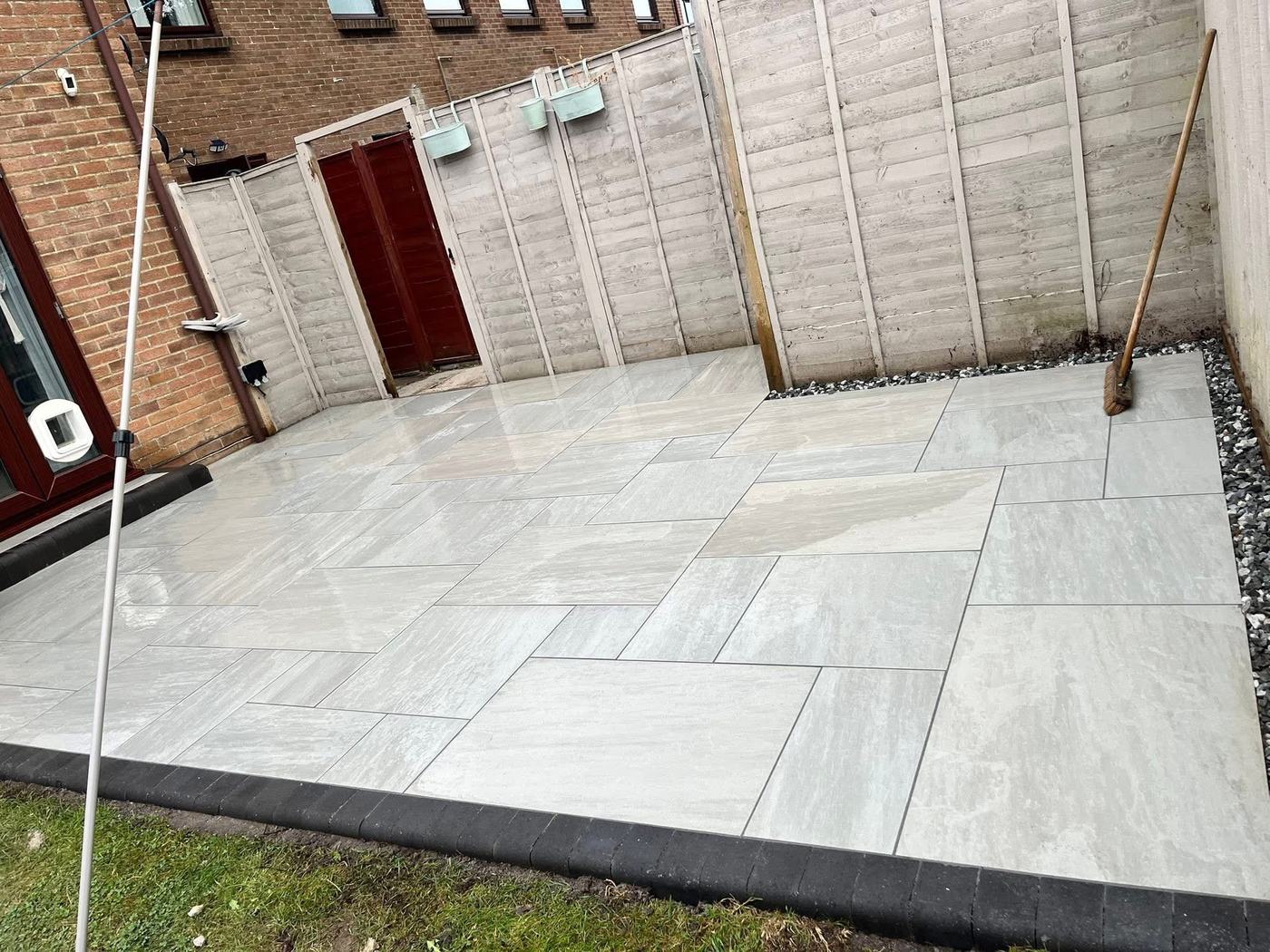
If you're planning a new patio, the choice usually comes down to two materials: porcelain or sandstone. Both look good on the day they're laid. The difference shows up a few winters later, and in how much time you want to spend looking after it.
We lay both across Poole, Bournemouth, Broadstone and Wimborne, so here's an honest comparison of how each one behaves in a Dorset garden, and how to work out which suits yours.
How porcelain behaves
Porcelain paving is made from fine clay fired at very high temperatures, which leaves a dense slab that barely takes on any water. That one property explains most of why it has become so popular. Water can't soak in, so it can't freeze inside the slab and crack it, which makes porcelain frost-proof. It also means spilt wine, barbecue fat and leaf stains tend to sit on the surface rather than sinking in, so most marks wipe or wash off.
Because it's manufactured, every slab is the same size and thickness, and the colour runs evenly across the whole patio. That gives a clean, modern finish with tight, straight joints. It suits contemporary houses, garden rooms and pool surrounds particularly well.
There are trade-offs. Porcelain is harder to cut than stone, and because it absorbs so little it needs a specific bonding primer on the back of each slab so it grips the mortar bed. Skip that step and slabs can work loose. It's a material that rewards an installer who knows it, and punishes one who lays it like ordinary stone.
How sandstone behaves
Natural sandstone, most often Indian sandstone in this country, is quarried rather than made. No two slabs are quite the same. The colours vary, the surface has a natural riven texture, and the whole patio has a softer, more traditional look. On an older property or in a cottage-style garden it can look more at home than porcelain.
Sandstone is porous, though. It takes on water, and with it dirt, algae and staining. Under trees, on a north-facing patio or anywhere that stays damp through the winter, it can go green and dark far quicker than people expect. It can be cleaned and it can be sealed, but it does need more looking after over the years.
The riven surface helps with grip in the wet, and it hides the odd mark well. Calibrated sandstone, cut to an even thickness, is easier to lay neatly than the older hand-split slabs.
Which handles our weather better
Dorset winters are mild compared with much of the country, but they're wet, and that's what matters for paving. A patio that stays damp from October to March is the real test.
Porcelain copes with that with very little help. Sandstone copes too, but expect some greening in shaded spots, and plan a proper clean every year or two. Near the coast, salt and wind-blown sand add to the wear on any surface, and the denser porcelain tends to shrug that off a little better.
Neither material will make up for a poor base, though. Most of the failures we're asked to put right, from rocking slabs to puddles that never drain, come down to what's underneath rather than the slab on top. A patio needs a solid sub-base, a full mortar bed and a gentle fall away from the house so rainwater runs off rather than sitting against the walls.
Looks and feel
This is the part only you can decide. Porcelain comes in a huge range of finishes, including some that copy natural stone very closely, but up close it still has a consistency that real stone doesn't. Sandstone has character and variation, and it weathers in over time, which some people love and others don't.
It helps to think about the house as well as the garden. A sharp modern extension with large glass doors often looks best with porcelain running straight out from the kitchen floor. A brick cottage with established borders may suit the warmer, varied tones of sandstone.
What drives the cost
We don't quote prices without seeing a garden, because the slab is only part of the bill. What makes the biggest difference is the size of the area, how much digging out and levelling is needed, whether there are steps, walls or drainage to build, and how much cutting the layout needs. Porcelain slabs often cost more to buy and take longer to cut, while sandstone can mean more time spent sorting and matching slabs on site. Once the groundwork is counted, the gap between the two is often smaller than people expect.
What we'd suggest
If you want a patio that looks the same in ten years with not much more than a wash, porcelain is hard to beat, and it's one of the materials we lay most often for that reason. If you'd rather have the look of natural stone and don't mind giving it a clean now and then, sandstone is a perfectly good choice, as long as it's laid on a proper base.
Whichever you go for, every patio we build comes with our 3-year workmanship guarantee, and we back the slabs themselves with a 5-year warranty. After 23 years in the trade, we'll tell you straight which one we think suits your garden and why.
If you're weighing up a new patio in Poole, Bournemouth, Broadstone, Wimborne or Ferndown, get in touch for a free quote and we'll come and take a look.