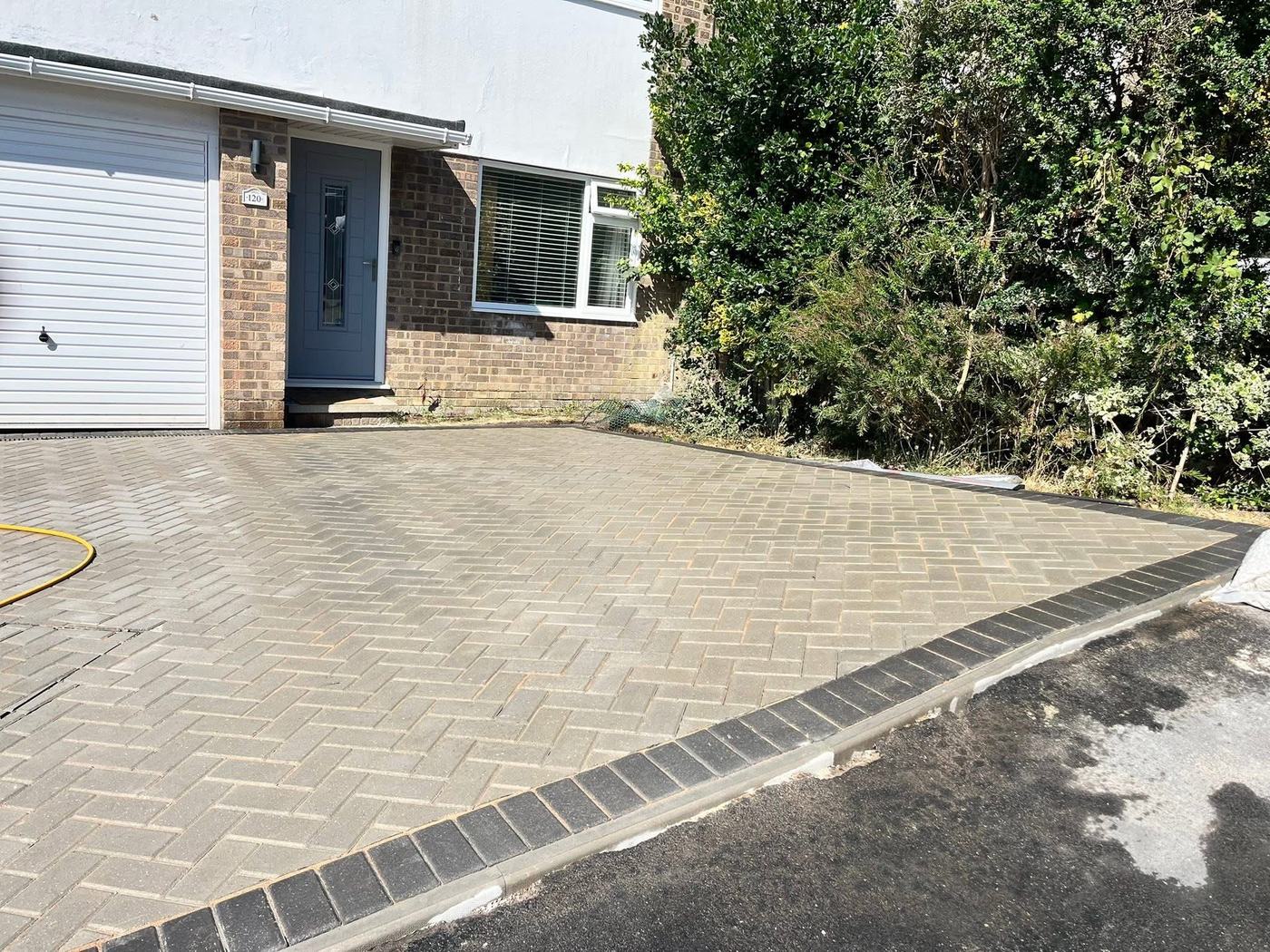
Looking after a driveway in winter matters, because most of the wear a driveway picks up happens between October and March. Leaves sit in the corners, rain stays on the surface for days, moss creeps into the joints and the odd frosty morning puts the whole thing under strain. None of that is a reason to worry, but a little care through the colder months goes a long way.
We lay resin and block paved driveways across Poole, Bournemouth, Broadstone and Wimborne, and the same questions come up every winter. Here's what actually helps, and what to avoid.
Clear leaves before they settle
Fallen leaves are the biggest winter job on any driveway. Left in a damp pile, they hold moisture against the surface, stain lighter colours and break down into the kind of rich, wet debris that moss and weeds love. On block paving, that debris washes into the joints and gives seeds somewhere to grow.
A stiff outdoor brush once a week through autumn is usually enough. Work from the house outwards so you're not sweeping everything back towards the door. A leaf blower is fine on resin and on block paving, as long as you don't use it to blast sand out of the joints.
Keep the water moving
Resin-bound driveways are permeable, so rainwater drains straight down through the surface rather than sitting on top. That only works while the surface stays open. Mud, silt and broken-down leaves can slowly clog it, and a clogged patch will start to hold puddles.
If you notice water lingering on a resin drive after rain, a gentle rinse with a hose and a firm brush usually clears it. Block paving relies on its falls and its drainage channels instead, so check that any channel drains or gullies at the edge of the drive aren't blocked with leaves. Water that can't get away is what causes most winter problems.
Moss, algae and weeds
Shaded driveways, especially ones under trees or on the north side of a house, can go green surprisingly quickly over a wet winter. On block paving, moss tends to start in the joints. On resin, it shows up as a dark film on the surface where it stays damp.
Regular brushing does most of the work. If it's already taken hold, a cleaner made for outdoor paving will shift it, and it's worth checking the label says it's suitable for resin before you use it on a resin drive. Pull weeds from block paving joints rather than scraping at them with anything metal, and top the joints back up with kiln-dried sand once they're dry so there's less room for the next lot.
Pressure washers, carefully
A pressure washer is tempting when a drive looks tired, but it's easy to do more harm than good. On block paving, a narrow jet aimed into the joints will strip out the sand that holds the blocks tight together, and loose blocks are the start of a drive that moves. On resin, holding the nozzle too close can roughen the surface.
If you do use one, keep it on a wide fan setting, hold it well back from the surface and work at an angle rather than straight down. On block paving, plan to re-sand the joints afterwards.
Frost, ice and grit
A well-built driveway shouldn't mind a frost. Resin-bound surfaces drain freely, so there's very little water left in them to freeze, and block paving laid on a proper sub-base can flex a little without cracking. Frost damage usually points to a problem underneath, such as a weak base or poor drainage, rather than the surface itself.
On icy mornings, a light scatter of grit or rock salt is generally fine on both block paving and resin. Sweep up what's left once the ice has gone so it isn't tracked into the house or left to sit on the surface. When clearing snow, use a plastic shovel rather than a metal one, and don't chip at ice with a spade, as that's an easy way to chip the surface too.
Watch out for heavy loads
Winter is when skips, scaffold and delivery lorries tend to turn up for indoor projects. Driveways are built for cars, and a heavy skip on a single point can mark or sink a section, especially if the ground is saturated. If you're having a skip, ask for boards underneath it, and keep it towards the strongest part of the drive if you can.
Small fixes before they grow
A loose block, a sunken corner or a small crack in an older drive is much easier to put right early than after a winter of water getting underneath. If you spot something, it's worth having it looked at before it spreads. Our work comes with a 3-year workmanship guarantee, and with 23 years in the trade Marc can usually tell you quickly whether something needs attention now or can wait until spring.
When it's time for something new
Sometimes winter just makes it obvious that an old driveway has had its day: puddles that never clear, a surface breaking up, weeds coming through everywhere. If that's where yours is, it's a good time to start planning. A new driveway takes some thought, and getting a quote in winter means you're ready to go when the weather turns.
If you're in Poole, Bournemouth, Broadstone, Wimborne or Ferndown and want an honest opinion on your driveway, get in touch for a free quote and we'll come and take a look.